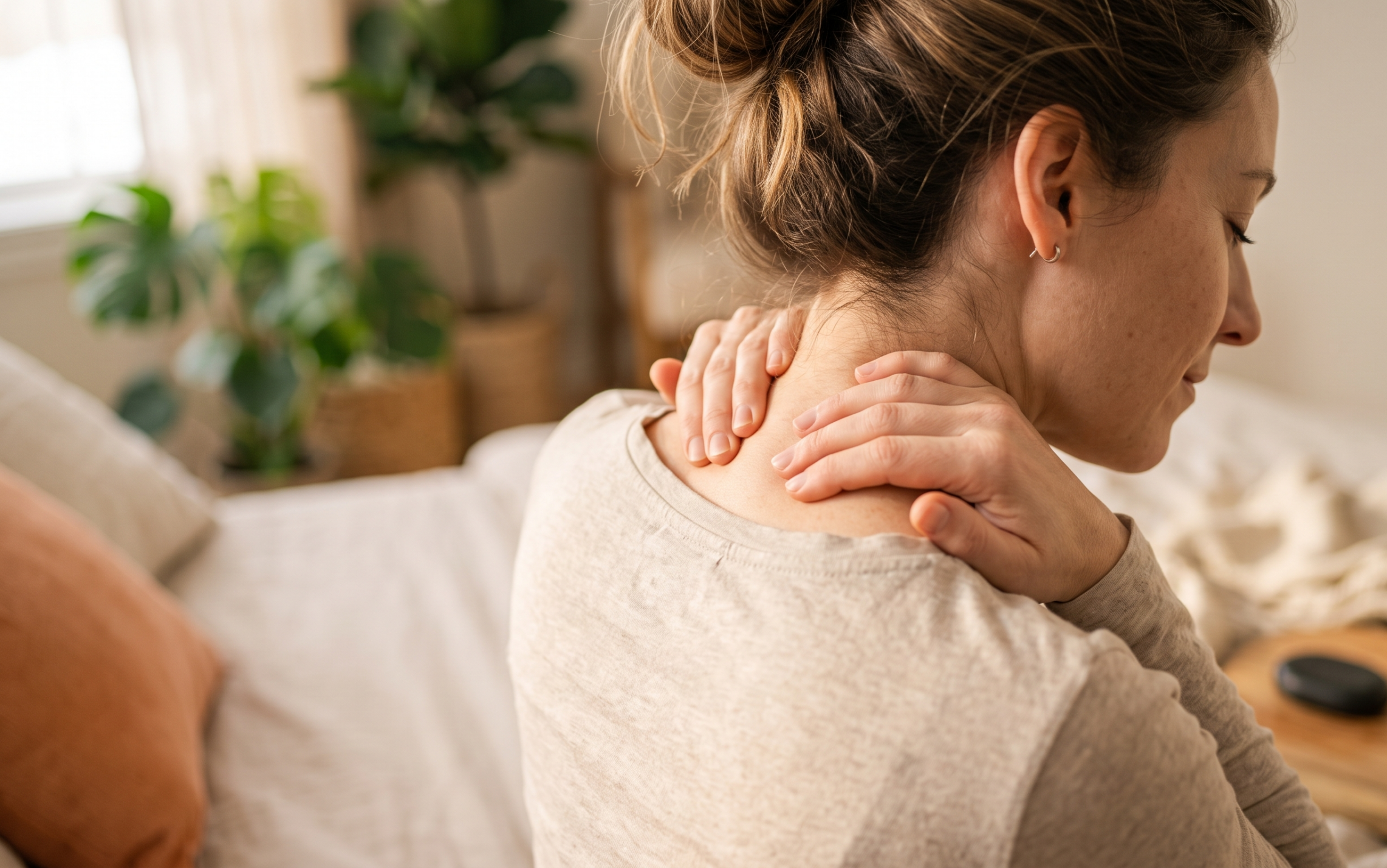
If you get tension headaches, you’ve probably noticed that pressing on certain spots in your neck or shoulders can either reproduce your headache or, sometimes, relieve it. Those spots are called trigger points, and they play a major role in tension headaches. Understanding where they are and how to release them can give you a powerful tool for managing your pain.
In this guide, we’ll map out the most common trigger points behind tension headaches, explain how to release them safely at home, and share when professional care makes the biggest difference. At Inspire Movements in Briargate, Colorado Springs, releasing these trigger points is one of the most reliable ways we help clients break the tension headache cycle.
|
What You’ll Learn in This Guide
|
- 1. What Are Trigger Points and How Do They Cause Headaches?
- 2. The Key Trigger Points Behind Tension Headaches
- 3. How to Release Trigger Points at Home
- 3.1 Upper Trapezius Release
- 3.2 Suboccipital Release
- 3.3 Levator Scapulae Release
- 3.4 Temporalis Release
- 4. Tools That Help With Self-Release
- 5. Why Professional Bodywork Reaches What You Can’t
- 6. When Headaches Need Medical Attention
- 7. Break the Headache Cycle in Colorado Springs
What Are Trigger Points and How Do They Cause Headaches?
A trigger point is a tight, hyperirritable knot within a muscle. When you press on it, it often feels tender, and it can refer pain to other areas, sometimes far from the knot itself. This referral pattern is the key to understanding tension headaches.
Many tension headaches aren’t actually caused by problems in the head at all. They’re caused by trigger points in the muscles of the neck, shoulders, and upper back that refer pain into the head. A trigger point in the upper trapezius, for example, can send pain up the side of the neck and into the temple. A trigger point in the suboccipital muscles at the base of the skull can create the classic “band around the head” sensation.
This is why treating the head itself often doesn’t work for tension headaches, and why releasing the trigger points in the neck and shoulders so often does. For the full picture on how tension headaches differ from migraines, see our tension headaches vs. migraines guide.
The Key Trigger Points Behind Tension Headaches
Here are the muscles most commonly responsible for tension headaches, where to find their trigger points, and the headache pattern each one creates:
| Muscle | Where It Is | Headache Pattern |
|---|---|---|
| Upper trapezius | Top of the shoulders, into the neck | Pain up the side of the neck into the temple |
| Suboccipitals | Base of the skull | Band around the head, behind the eyes |
| Levator scapulae | Side and back of the neck | Stiff neck, pain at the neck and skull junction |
| Sternocleidomastoid (SCM) | Front and side of the neck | Pain behind the eye, forehead, around the ear |
| Temporalis | Side of the head, above the ear | Temple pain, tooth and jaw pain |
According to research indexed on PubMed, active trigger points in the suboccipital, upper trapezius, sternocleidomastoid, and temporalis muscles are associated with tension-type headache, and the pain pattern of these headaches is often produced by referred pain from these trigger points.
How to Release Trigger Points at Home
You can address many of these trigger points yourself with gentle, sustained pressure. Here’s how to do it safely:
Upper Trapezius Release
Reach across your body and grasp the muscle on top of your opposite shoulder between your fingers and thumb. Squeeze gently and hold the tender spot for 30 to 60 seconds until you feel it begin to soften. Breathe deeply throughout. Repeat on the other side.
Suboccipital Release
Lie on your back and place two tennis balls (or a peanut-shaped massage tool) at the base of your skull, one on each side of your spine. Let the weight of your head rest into them. Hold for 1 to 2 minutes, breathing slowly. This is one of the most effective releases for the “band around the head” type of tension headache.
Levator Scapulae Release
Use a massage ball against a wall, positioned where your neck meets your shoulder at the back. Lean into it and slowly move until you find the tender spot, then hold steady pressure for 30 to 60 seconds.
Temporalis Release
Place your fingertips on your temples and make slow, small circles with gentle pressure. If you clench or grind your teeth, this muscle is often a major contributor. Spend 1 to 2 minutes here, especially if you feel tension in your jaw.
|
A Note on Pressure Trigger point release should feel like “good pain,” a tender pressure that eases as you hold it. It should never be sharp, intense, or make your headache dramatically worse. If pressing on a spot makes your symptoms spike, ease off. Gentle and sustained always beats aggressive. |
Tools That Help With Self-Release
You don’t need anything fancy, but a few inexpensive tools make self-release easier:
- Tennis balls or massage balls. Perfect for the suboccipitals and levator scapulae. Two balls in a sock creates a “peanut” shape ideal for the base of the skull.
- A foam roller. Useful for the upper back and broader shoulder tension that feeds into headaches.
- A handheld massage tool. Helpful for reaching trigger points you can’t easily access with your hands.
- Just your hands. For the trapezius and temporalis, your own fingers work perfectly well.
|
Can’t Reach the Tension Yourself? Book a session with Jessica at Inspire Movements for targeted release of the trigger points driving your headaches. |
Why Professional Bodywork Reaches What You Can’t
Self-release is a powerful tool, but it has real limits. Many of the deepest and most stubborn trigger points (especially in the suboccipitals and the deep layers of the neck) are difficult to fully release on your own. You can’t always reach them, you can’t always apply sustained pressure at the right angle, and you can’t relax fully while working on yourself.
This is where therapeutic massage makes a real difference. Ashiatsu massage uses broad, sustained pressure that’s exceptional for releasing the upper trapezius and the muscles around the cervical spine, the primary drivers of tension headaches. The sustained nature of the pressure allows these chronically tight muscles to fully let go in a way that brief self-pressure often can’t achieve.
For headache clients with especially stubborn upper-body tension, we often add cupping therapy to release the fascial restrictions that hold trigger points in place. Many clients find that combining home self-release with regular professional sessions dramatically reduces how often they get headaches at all.
When Headaches Need Medical Attention
Most tension headaches are benign and respond well to trigger point release and massage. But certain warning signs require medical evaluation. See a doctor right away if you experience:
- The “worst headache of your life,” sudden and severe
- Headache after a head injury or fall
- Headache with fever, stiff neck, confusion, or weakness
- Headache with vision loss or speech changes
- A new headache pattern in someone over 50
- Headaches that progressively worsen over days or weeks
These can signal conditions that need medical care. Trigger point release and massage are excellent for everyday tension headaches but are not a substitute for medical evaluation when these signs are present.
Break the Headache Cycle in Colorado Springs
Tension headaches driven by trigger points are very treatable. With consistent self-release, smart posture and stress habits, and targeted professional bodywork when you need it, many people go from frequent headaches to occasional ones, or eliminate them entirely.
At Inspire Movements, we serve clients throughout Briargate, Research Parkway, Academy Boulevard, and the I-25 corridor in Colorado Springs. Jessica’s training in ashiatsu, cupping, and integrative pain therapy means every session targets the specific trigger points and muscle patterns behind your headaches.
If you’ve been managing headaches on your own and need help reaching the tension you can’t release yourself, we’d love to help.
|
Ready to Release the Tension? Book your first session with Jessica at Inspire Movements and target the trigger points driving your headaches. Located in Briargate, Colorado Springs. |