
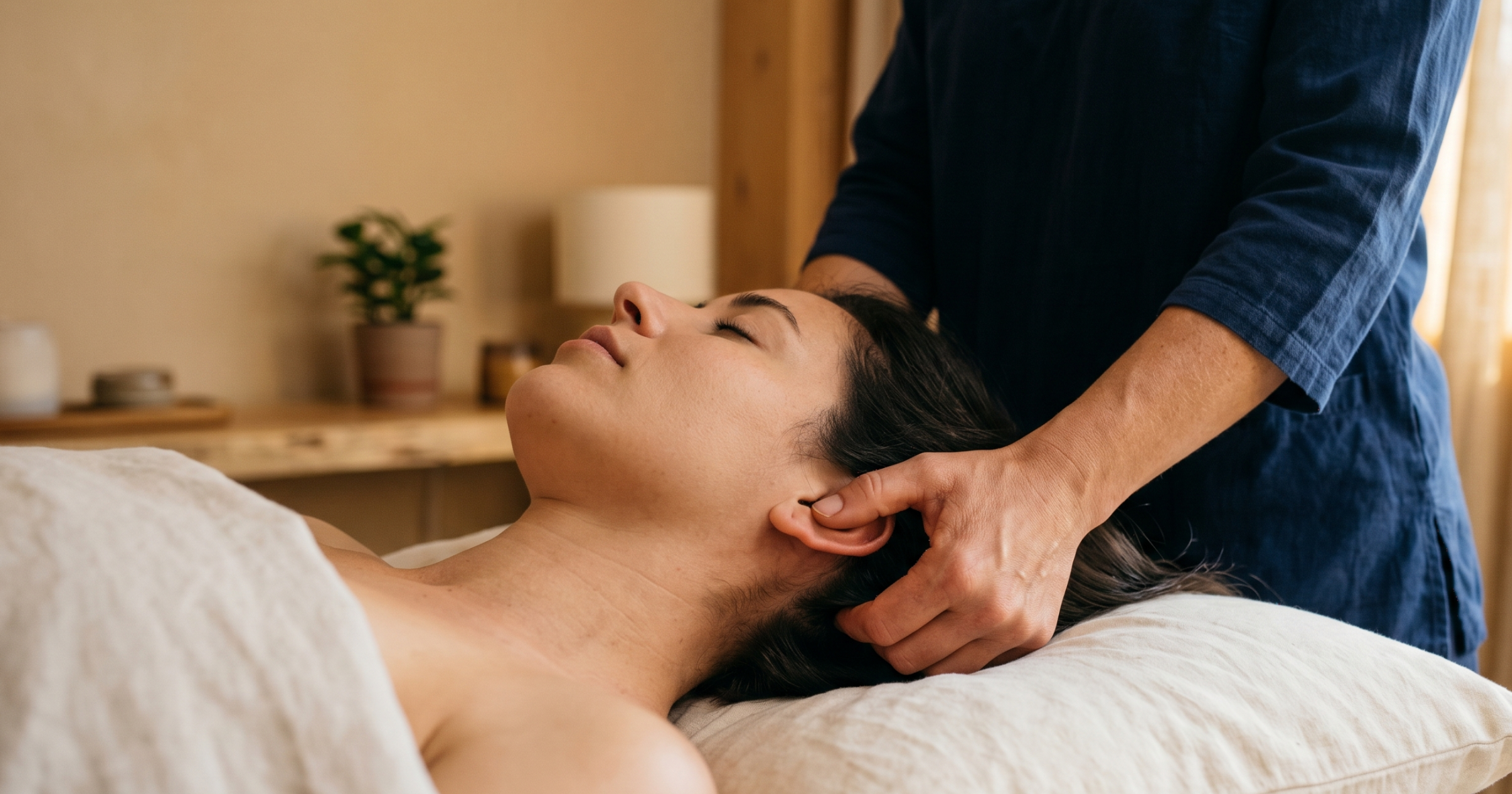
If you regularly deal with head pain, you’ve probably wondered: is this a tension headache or a migraine? The difference matters more than most people realize. Tension headaches and migraines have different causes, different symptoms, and respond to different treatments. The good news is that both can be significantly improved with the right kind of therapeutic massage. But only when you understand what’s actually driving your pain.
According to the National Institute of Neurological Disorders and Stroke, headaches are one of the most common forms of pain and a leading reason people miss work or visit a healthcare provider. In this guide, we’ll walk through how to tell tension headaches and migraines apart, what causes each one, what the research says about non-drug treatment, and how the targeted massage therapies at Inspire Movements in Briargate help break the headache cycle.
- 1 What You’ll Learn in This Guide
- 1. What Is a Tension Headache?
- 2. What Is a Migraine?
- 3. Tension Headaches vs. Migraines: Quick Comparison
- 4. What Causes These Headaches?
- 4.1 Causes of Tension Headaches
- 4.2 Causes of Migraines
- 4.3 Tired of Living With Chronic Headaches?
- 5. What the Research Says About Massage for Headaches
- 6. How Massage Therapy Provides Relief
- 6.1 For Tension Headaches
- 6.2 For Migraines
- 6.3 For the Stress-Pain Cycle
- 7. Best Massage Modalities for Headaches
- 7.1 Ashiatsu Massage
- 7.2 Cupping Therapy
- 7.3 Red Light Therapy
- 8. How Often Should You Get a Massage for Headaches?
- 9. When to See a Doctor Instead
- 10. Lifestyle Factors That Support Headache Relief
- 11. Find Headache Relief in Colorado Springs
- 11.1 Start Breaking the Headache Cycle
What You’ll Learn in This Guide
- The key differences between tension headaches and migraines
- What causes each type and the most common triggers
- How to recognize which type you’re experiencing
- What the research says about massage for headache relief
- How massage therapy actually works to provide relief
- Which massage modalities work best for each type
- When to see a doctor instead of (or in addition to) a massage therapist
What Is a Tension Headache?
Tension headaches are the most common type of headache and are typically caused by tight muscles in the shoulders, neck, scalp, and jaw. According to the National Center for Complementary and Integrative Health, tension headaches are often related to stress, anxiety, depression, poor sleep, or working long hours without breaks.
The pain of a tension headache is usually:
- Mild to moderate intensity: uncomfortable but typically not debilitating
- Felt on both sides of the head: often described as a tight band or pressure
- Steady and dull rather than throbbing or pulsing
- Accompanied by neck or shoulder tightness: usually with tender, knotted muscles
- Triggered or worsened by stress, posture, or fatigue
Tension-type headaches can last anywhere from 30 minutes to 7 days. Some people experience chronic tension headaches, defined by NIH researchers as having more than 15 headache days per month, meaning more days with headache than without. This is the kind of pattern we see most often at our Briargate practice in clients who work long hours at desks, drive long commutes, or carry chronic stress in their upper body.
What Is a Migraine?
Migraines are fundamentally different from tension headaches. The National Institute of Neurological Disorders and Stroke describes migraine not as a headache but as a complex brain condition. As one NIH-funded researcher puts it, migraine is essentially a disorder where the “volume knob” of the nervous system has been turned up, making the brain hypersensitive to stimulation.
Migraine attacks typically include:
- Throbbing or pulsing pain: usually on one side of the head, but can be on both
- Moderate to severe intensity: often debilitating
- Sensitivity to light, sound, and smells: leading many people to seek out dark, quiet spaces
- Nausea, vomiting, or appetite changes
- Visual disturbances or aura in some cases, like flashing lights, blind spots, or zigzag patterns
- Worsening with physical activity: even simple movement can intensify pain
- Duration of hours to days
Migraines often have identifiable triggers like hormonal shifts, certain foods, weather changes (especially relevant in Colorado Springs), poor sleep, or chronic stress. Read more about how Colorado’s unique climate affects migraine patterns in our piece on seasonal headache patterns and Colorado weather.
Tension Headaches vs. Migraines: Quick Comparison
Here’s a side-by-side breakdown to help you identify which type you’re experiencing:
| Feature | Tension Headache | Migraine |
|---|---|---|
| Pain quality | Dull, pressure, tight band | Throbbing, pulsing |
| Location | Both sides, usually | Often one-sided |
| Severity | Mild to moderate | Moderate to severe |
| Duration | 30 min to 7 days | 4 to 72 hours typical |
| Light/sound sensitivity | Rare | Very common |
| Nausea/vomiting | Rare | Common |
| Aura/visual changes | No | Sometimes |
| Effect of physical activity | Often improves with movement | Worsens with movement |
| Common triggers | Stress, posture, fatigue | Hormones, food, weather, sleep |
It’s worth noting that tension headaches and migraines aren’t always cleanly separable. Research shows the two conditions share characteristics. Both can be triggered by psychological stress, both respond to similar lifestyle interventions, and people who get migraines often experience tension headaches too. In some cases, chronic tension can actually trigger migraine attacks in people who are already prone to them.
What Causes These Headaches?
Understanding the root cause matters because it determines the best approach for relief. Here’s what’s typically happening underneath each type:
Causes of Tension Headaches
Tension headaches almost always trace back to muscular tension in specific regions: the suboccipital muscles at the base of the skull, the upper trapezius across the shoulders, the levator scapulae running from the shoulder blade up to the neck, and the temporalis and masseter muscles around the jaw. When these muscles stay tight for hours, days, or weeks, they restrict blood flow, irritate nearby nerves, and refer pain into the head.
Common contributing factors include:
- Prolonged desk work and forward-head posture
- Chronic emotional stress and anxiety
- Jaw clenching or teeth grinding
- Poor sleep posture or low-quality sleep
- Eye strain from screens
- Dehydration
- Holding phones between ear and shoulder
Causes of Migraines
Migraine is more complex. While the exact mechanism is still being researched, NIH-funded studies have identified that migraines involve changes in brain chemistry, blood vessel function, and nerve activity, particularly involving the trigeminal nerve and serotonin pathways. People with migraines often have a genetic predisposition that makes their nervous system more reactive to triggers.
Common migraine triggers include:
- Hormonal changes (especially in women: menstruation, pregnancy, menopause)
- Specific foods (aged cheeses, processed meats, alcohol, caffeine withdrawal)
- Weather changes (barometric pressure shifts, common in Colorado)
- Poor or irregular sleep
- Bright or flickering lights
- Strong smells
- Skipped meals or dehydration
- Acute or chronic stress (and the “letdown” after stress)
Tired of Living With Chronic Headaches?
Book a session with Jessica at Inspire Movements and start addressing the root cause.
What the Research Says About Massage for Headaches
Massage therapy has long been used for headache relief, but what does the science say? The National Center for Complementary and Integrative Health notes that the evidence specifically for massage and headaches is limited, but research increasingly supports complementary approaches as part of a broader headache management strategy.
The clinical reality at our practice is consistent and clear: clients with chronic tension headaches almost universally see improvement with regular massage therapy that targets the muscles driving the pain. For migraine clients, results are often more nuanced. Massage may not stop a migraine in progress, but it can reduce frequency, severity, and duration over time when the underlying neck and shoulder tension is addressed.
The bigger picture is that headaches are a top contributor to opioid prescriptions and chronic medication use. As mainstream medicine increasingly looks for non-drug, non-invasive options, hands-on therapies like massage are gaining ground as a meaningful part of the treatment toolbox.
How Massage Therapy Provides Relief
Massage approaches each headache type differently. Here’s how it works:
For Tension Headaches
Tension headaches respond best to direct work on the muscles causing the pain. Sustained pressure on the suboccipital muscles at the base of the skull can decompress the occipital nerves and provide immediate relief. Many clients describe this work as “the moment my headache lifted.” Releasing the upper trapezius and levator scapulae addresses the chronic shoulder-and-neck tension that fuels recurring headaches. Jaw and facial muscle release can be transformative for people who clench or grind.
When tension headaches are caught early and addressed consistently, many clients reduce their frequency from multiple times per week to occasional flare-ups, often eliminating chronic headache patterns entirely.
For Migraines
Migraine work is different. Trying to deeply massage someone in the middle of an active migraine is usually counterproductive. The nervous system is already in overdrive, and intense pressure can make symptoms worse. Instead, the goal is preventive: reducing the muscular tension and nervous system load that contribute to migraine frequency.
Bi-weekly massage between attacks can dramatically reduce how often migraines occur. The combination of releasing chronic neck and shoulder tension, calming the parasympathetic nervous system, and lowering baseline cortisol levels addresses several known migraine triggers at once. For an in-depth case study, read our piece on how parents in Colorado Springs are fighting migraines with bi-weekly ashiatsu massages.
For the Stress-Pain Cycle
Both tension headaches and migraines feed off the same underlying issue: chronic nervous system activation. When the body lives in fight-or-flight mode, muscles stay tight, sleep quality drops, cortisol stays elevated, and headache pathways stay primed. Massage interrupts this cycle by activating the parasympathetic nervous system, which is why many clients notice that their headache patterns improve after just a few sessions, even before any specific muscle work has fully resolved. For a deeper dive on this, see how emotional stress fuels physical pain symptoms.
Best Massage Modalities for Headaches
Different modalities offer different benefits for headache relief. Here’s how we approach each one at Inspire Movements:
Ashiatsu Massage
The broad, sustained pressure of ashiatsu is exceptional for releasing the upper trapezius, levator scapulae, and the muscles surrounding the cervical spine. These are all primary drivers of tension headaches. The parasympathetic-activating effect also makes ashiatsu valuable as part of a migraine prevention plan. Many of our headache clients consider ashiatsu their primary pain relief tool.
Cupping Therapy
Cupping along the upper back, shoulders, and neck can release fascial restrictions that have been holding chronic tension patterns in place for years. For headache clients with stubborn upper-body tightness that doesn’t respond to traditional massage alone, cupping often unlocks new layers of relief.
Red Light Therapy
Red light therapy reduces inflammation and supports tissue recovery, particularly helpful for clients dealing with chronic neck and upper-back inflammation that contributes to recurring headaches. Often used as an add-on to ashiatsu sessions for amplified results.
How Often Should You Get a Massage for Headaches?
Frequency depends on the type and severity of your headaches. Here’s how we typically structure care plans:
| Headache Pattern | Recommended Frequency | Focus Areas |
|---|---|---|
| Chronic tension headaches | Weekly for 4-6 weeks, then bi-weekly | Neck, shoulders, jaw, suboccipitals |
| Frequent migraines | Bi-weekly preventive | Upper back, shoulders, nervous system |
| Occasional tension headaches | Monthly maintenance | Full upper body |
| Mixed (tension + migraine) | Weekly, then bi-weekly | Comprehensive upper body + nervous system |
| Stress-related headaches | Bi-weekly | Full body relaxation focus |
Most clients see meaningful improvement within 4-6 sessions. The key is consistency. Chronic headache patterns developed over months or years won’t resolve in a single session, but they almost always improve with the right rhythm of care.
When to See a Doctor Instead
While most headaches are tension or migraine-based and respond well to massage, certain warning signs require medical evaluation. See your doctor immediately if you experience:
- The “worst headache of your life”: sudden, severe onset
- Headache after a head injury or fall
- Headache with fever, stiff neck, confusion, or weakness
- Headache with vision loss or speech changes
- A new pattern of headaches in someone over 50
- Headaches that progressively worsen over days or weeks
- Headaches that disrupt daily life for more than a few days at a time
Massage therapy works best as a complement to medical care, not a replacement for it. We frequently see clients who use massage alongside their neurologist’s treatment plan to reduce headache frequency, lower medication needs, and improve overall quality of life.
Lifestyle Factors That Support Headache Relief
Massage works best when paired with daily habits that reduce headache triggers. The factors that consistently make the biggest difference for our headache clients:
- Hydration: Even mild dehydration is a common headache trigger.
- Consistent sleep schedule: Sleep irregularity is one of the most common migraine triggers and worsens tension headaches.
- Workspace ergonomics: Monitor at eye level, supportive chair, frequent breaks.
- Stress management: Breathwork, walking, time outside, whatever your tools are, use them.
- Trigger tracking: A simple headache journal (date, severity, possible triggers) helps you and your providers identify patterns.
- Regular movement: Even short daily walks help reduce both tension and migraine frequency.
- Limiting screen time before bed: Eye strain and disrupted sleep are a double trigger.
Find Headache Relief in Colorado Springs
Living with chronic tension headaches or recurring migraines doesn’t have to be your normal. Many of our clients arrive having tried medication, chiropractic care, and lifestyle changes without lasting results. They find that consistent massage therapy is the missing piece that finally breaks the cycle.
At Inspire Movements, we serve clients throughout Briargate, Research Parkway, Academy Boulevard, and the I-25 corridor in Colorado Springs. Jessica’s training in ashiatsu, cupping, and integrative pain therapy means every session is tailored to whether you’re managing tension headaches, migraines, or both, addressing the muscle patterns and nervous system load that fuel each one.
If you’ve been searching for a real, hands-on approach to headache relief that addresses the root cause instead of just managing symptoms, we’d love to be part of your recovery.
Start Breaking the Headache Cycle
Book your first session with Jessica at Inspire Movements and discover what real, lasting headache and migraine relief feels like. Located in Briargate, Colorado Springs.