Sciatica pain has a way of stopping you in your tracks. That sharp, radiating discomfort down the back of your leg can make sitting, standing, sleeping, and walking all feel difficult. The good news is that for many people, simple at-home stretches can provide meaningful relief, especially when done consistently and combined with the right therapeutic care.
In this guide, we’ll walk through five effective stretches you can do at home to ease sciatica pain, explain why each one works, and share when it’s time to stop stretching and seek professional care. At Inspire Movements in Briargate, Colorado Springs, we treat sciatica regularly and have seen firsthand how powerful the combination of consistent stretching and targeted massage can be.
|
What You’ll Learn in This Guide
|
- 1. What Is Sciatica and Why Does Stretching Help?
- 2. Before You Start: A Few Important Notes
- 3. Stretch 1: Knee-to-Chest Stretch
- 3.1 How to do it:
- 4. Stretch 2: Piriformis Stretch (Figure-Four)
- 4.1 How to do it:
- 5. Stretch 3: Seated Spinal Twist
- 5.1 How to do it:
- 6. Stretch 4: Standing Hamstring Stretch
- 6.1 How to do it:
- 7. Stretch 5: Cat-Cow Stretch
- 7.1 How to do it:
- 8. How Often Should You Do These Stretches?
- 9. Common Mistakes That Can Make Sciatica Worse
- 10. When Stretching Isn’t Enough
- 11. When to See a Doctor First
- 12. Find Sciatica Relief in Colorado Springs
What Is Sciatica and Why Does Stretching Help?
Sciatica is the term used to describe pain that radiates along the path of the sciatic nerve, which runs from your lower back through your hips and glutes and down each leg. According to the National Institute of Neurological Disorders and Stroke, sciatica typically affects only one side of the body and is usually caused by a herniated disc, bone spur, or spinal stenosis compressing part of the nerve.
But here’s something many people don’t realize: a significant portion of sciatica-like pain isn’t actually nerve compression from the spine. It’s often caused by tight muscles in the hips and glutes (especially the piriformis muscle) putting pressure on the sciatic nerve as it passes through. This type of pain responds especially well to stretching.
Stretching helps in several ways. It lengthens tight muscles that may be compressing the nerve, improves blood flow to the affected area, reduces inflammation, and helps reset the protective bracing patterns that chronic pain creates. The five stretches below target the muscles most commonly involved in sciatica pain and can be done at home with no equipment.
Before You Start: A Few Important Notes
Stretching for sciatica works best when you follow a few simple principles:
- Gentle is better than aggressive. You should feel a stretch but never sharp pain. Pain means stop.
- Hold, don’t bounce. Static holds of 20 to 30 seconds are more effective than ballistic stretching.
- Breathe through each stretch. Deep breathing helps muscles relax and lengthen.
- Consistency beats intensity. Daily gentle stretching helps more than occasional aggressive sessions.
- Listen to your body. If a stretch makes your symptoms worse, stop and try a different one.
If you have any of the warning signs we list at the end of this article, see a doctor before starting any stretching routine. Sciatica caused by certain conditions can be made worse by the wrong kind of movement.
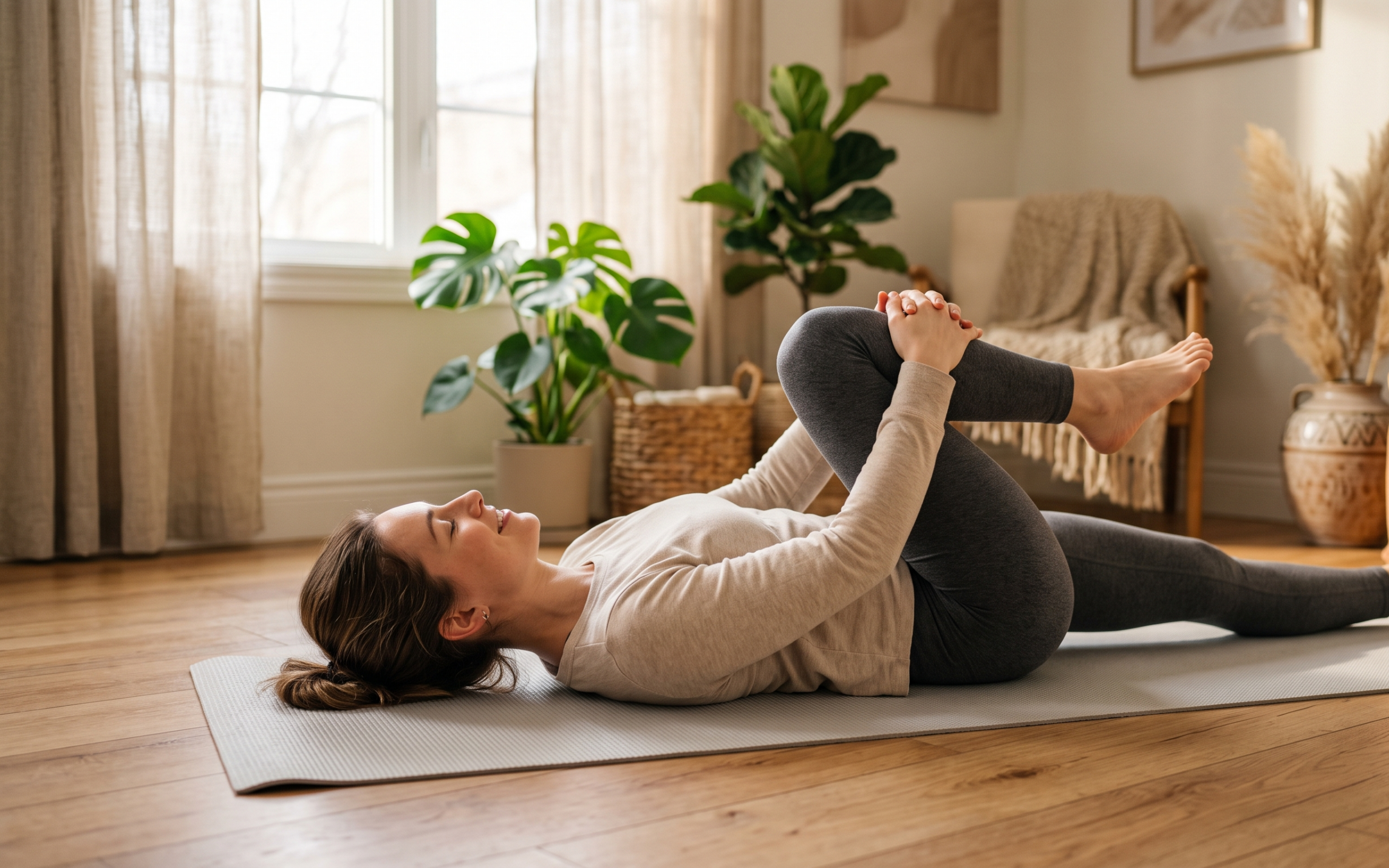
Stretch 1: Knee-to-Chest Stretch
This gentle stretch lengthens the lower back muscles and helps relieve pressure on the lumbar spine. It’s a great first stretch because it’s low-risk and works well even when other movements feel too intense.
How to do it:
- Lie flat on your back on a mat or carpeted floor
- Bend both knees with your feet flat on the floor
- Slowly bring one knee up toward your chest, clasping your hands behind your thigh
- Keep your other foot flat on the floor or extend the leg flat
- Hold for 20 to 30 seconds, breathing deeply
- Slowly release and switch sides
Reps: 3 times per leg, once or twice daily. Do the painful side first, then the other side. Many people find this stretch immediately relieving for lower back tension.
Stretch 2: Piriformis Stretch (Figure-Four)
The piriformis is a small muscle deep in the buttock that the sciatic nerve runs underneath (and in some people, through). When the piriformis tightens, it can compress the sciatic nerve and create classic sciatica symptoms. Stretching this muscle is often the single most effective thing you can do for piriformis-related sciatica.
How to do it:
- Lie on your back with both knees bent and feet flat on the floor
- Cross your right ankle over your left knee, making a “4” shape
- Reach your hands through the gap and clasp behind your left thigh
- Gently pull your left thigh toward your chest
- You should feel the stretch deep in your right glute
- Hold for 30 seconds, breathing deeply
- Release and switch sides
Reps: 3 times per side, once or twice daily. For deep piriformis tightness that doesn’t fully release with stretching, our ashiatsu massage for sciatica relief can reach deeper than self-stretching alone.
Stretch 3: Seated Spinal Twist
This stretch targets the deeper glute muscles, lower back, and the muscles along the spine. It also helps mobilize the spine itself, which can be especially helpful if your sciatica is related to disc issues or stiffness in the lumbar region.
How to do it:
- Sit on the floor with your legs extended in front of you
- Bend your right knee and place your right foot on the outside of your left thigh
- Place your right hand on the floor behind you for support
- Twist your torso to the right, bringing your left elbow to the outside of your right knee
- Look over your right shoulder
- Hold for 30 seconds, breathing deeply
- Slowly unwind and switch sides
Reps: 2 to 3 times per side, once daily. Avoid this stretch if you have a known disc issue and twisting makes your pain worse.
|
Stretching Alone Isn’t Cutting It? Book a session with Jessica at Inspire Movements and get targeted massage therapy that complements your home routine. |
Stretch 4: Standing Hamstring Stretch
Tight hamstrings are one of the most common contributors to sciatica pain. When the hamstrings shorten, they pull on the pelvis and lower back, which can increase pressure on the sciatic nerve. Loosening them often provides significant relief.
How to do it:
- Stand facing a chair, low bench, or step
- Place one heel on the surface, keeping that leg straight
- Keep your standing leg slightly bent
- Slowly hinge forward from your hips (not your back) until you feel a stretch in the back of your raised leg
- Keep your spine long, not rounded
- Hold for 30 seconds, breathing deeply
- Switch sides
Reps: 2 to 3 times per leg, once daily. Hinging from the hips (not rounding the back) is critical for safety. Rounding the back during hamstring stretches can aggravate disc issues.
Stretch 5: Cat-Cow Stretch
This gentle yoga-based movement mobilizes the entire spine, improves circulation through the lower back, and can help reduce stiffness that contributes to sciatica. It’s especially good as a morning stretch or after long periods of sitting.
How to do it:
- Start on your hands and knees, with your wrists under your shoulders and knees under your hips
- Cow: Inhale, drop your belly toward the floor, lift your chest and tailbone toward the ceiling
- Cat: Exhale, round your back toward the ceiling, tuck your chin and tailbone
- Move slowly between the two positions, syncing with your breath
- Continue for 1 to 2 minutes
Reps: 10 to 15 cycles, once or twice daily. This is a great stretch to start your day with, especially if you wake up with stiffness. For more on how morning stiffness contributes to lower back pain, see our companion piece on chronic low back pain causes and treatment in our chronic low back pain massage therapy guide.
How Often Should You Do These Stretches?
Frequency matters more than intensity. Here’s a realistic routine that produces results:
| Phase | Frequency | What to Expect |
|---|---|---|
| Acute pain (Week 1) | Gentle stretches, 2x daily | Mild relief, focus on knee-to-chest and cat-cow |
| Recovery (Weeks 2-4) | All 5 stretches, daily | Noticeable improvement in pain levels and mobility |
| Maintenance (Ongoing) | 3 to 4 times per week | Preventing recurrence, maintaining flexibility |
Many people see meaningful improvement within 2 to 4 weeks of consistent stretching. If you’re not seeing improvement after a few weeks, that’s a signal that something deeper may be going on, and professional care can help identify what.
Common Mistakes That Can Make Sciatica Worse
Stretching is generally safe, but a few common mistakes can actually aggravate sciatica:
- Forcing the stretch through pain. Pain is a signal to stop, not push through. Sharp, shooting, or radiating pain means the stretch isn’t right for you.
- Rounding your back during forward folds. This puts extra pressure on the discs and can worsen disc-related sciatica. Always hinge from the hips with a long spine.
- Holding your breath. Breath holding tightens muscles. Deep, slow breathing helps the body relax and the stretch deepen naturally.
- Only stretching when in pain. Stretches work as prevention as much as treatment. Maintaining flexibility prevents flare-ups.
- Stretching cold. Cold muscles tear more easily. A few minutes of gentle movement first (walking, marching in place) warms tissue and makes stretching safer.
When Stretching Isn’t Enough
Stretching is powerful but it has limits. The muscles most commonly involved in sciatica (especially the piriformis and deep gluteal muscles) are notoriously difficult to fully release with self-stretching alone. They sit deep beneath other muscles and respond best to a combination of stretching plus skilled hands-on bodywork.
If you’ve been stretching consistently for 3 to 4 weeks and your pain hasn’t improved (or has gotten worse), it’s worth considering professional support. At Inspire Movements, we use ashiatsu massage to reach the deeper glute and hip muscles that self-stretching can’t fully access. We also frequently add cupping therapy to release fascial restrictions around the sciatic nerve pathway.
Most of our sciatica clients find that combining home stretching with regular massage produces better results than either approach alone. Stretching maintains mobility between sessions, while massage breaks through the deeper tension that builds up over time.
When to See a Doctor First
While most sciatica responds well to stretching and conservative care, certain warning signs require medical evaluation before any home routine. According to Harvard Health Publishing, you should see a doctor immediately if you experience:
- Loss of bladder or bowel control
- Severe weakness in the leg, not just pain
- Numbness in the saddle area (groin and inner thighs)
- Pain following a fall, accident, or injury
- Fever, unexplained weight loss, or other systemic symptoms with the pain
- Progressive worsening despite rest and home care
These can be signs of more serious conditions that need medical evaluation. Massage and stretching are excellent complements to medical care but not a replacement for it when warning signs are present.
Find Sciatica Relief in Colorado Springs
Sciatica doesn’t have to control your life. With consistent stretching, smart lifestyle adjustments, and the right professional support when needed, real relief is possible, even if you’ve been dealing with pain for months or years.
At Inspire Movements, we serve clients throughout Briargate, Research Parkway, Academy Boulevard, and the I-25 corridor in Colorado Springs. Jessica’s training in ashiatsu, cupping, and integrative pain therapy means every sciatica session is tailored to your specific pattern, whether your pain is driven by piriformis tightness, disc compression, or chronic muscle imbalances.
If you’ve been stretching at home and need something that reaches deeper, we’d love to help you find lasting relief.
|
Ready to Address Your Sciatica? Book your first session with Jessica at Inspire Movements and combine your home stretching with targeted therapeutic massage. Located in Briargate, Colorado Springs. |