
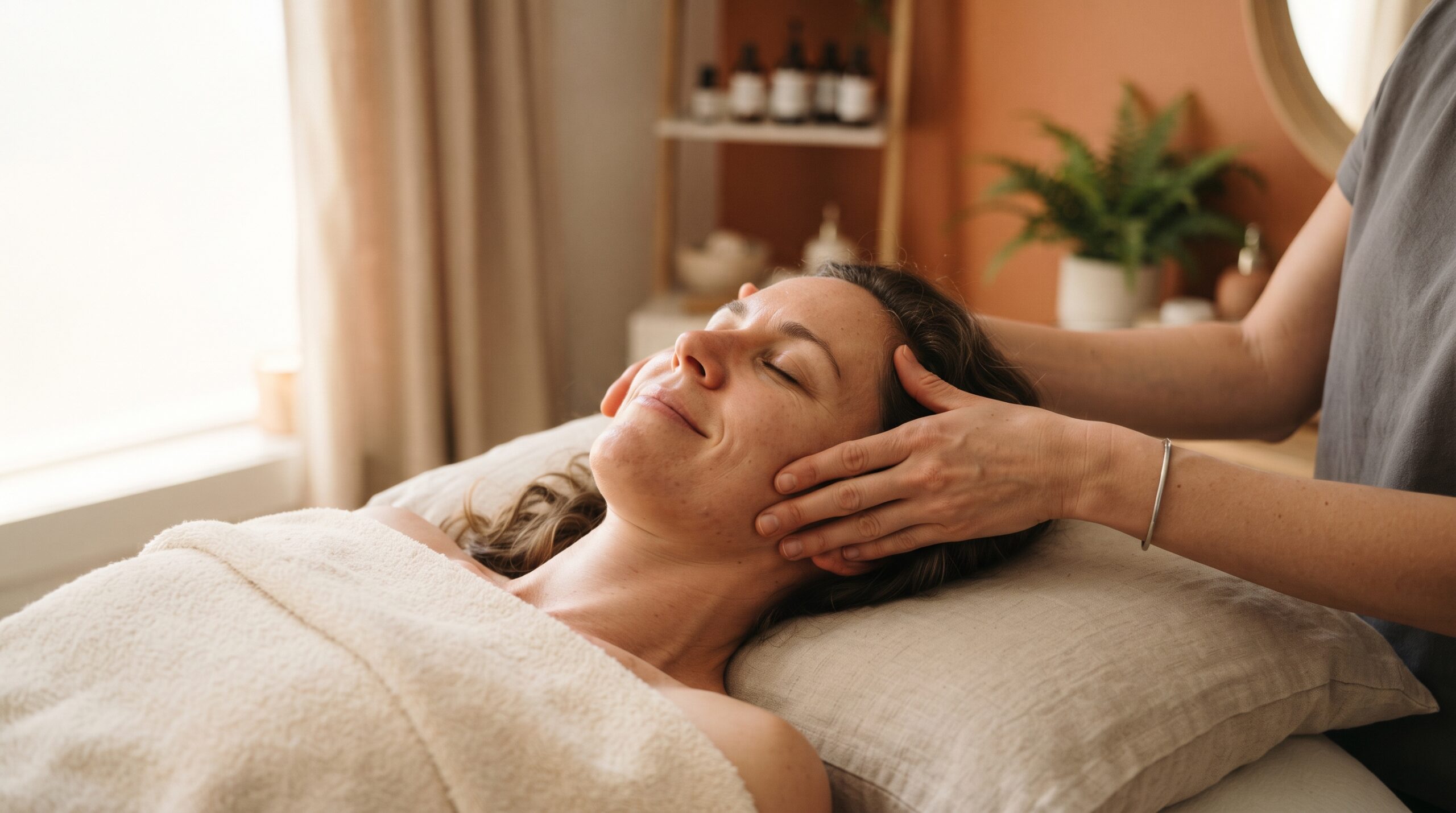
If your headaches seem to start at your temples, show up first thing in the morning, or arrive alongside a sore, tired jaw, the problem may not start in your head at all. It may start in your jaw. Jaw tension and temporomandibular disorders (often called TMJ or TMD) are a common and frequently overlooked source of recurring head pain.
In this guide, we will explain how the jaw and head are connected, the signs that your headaches may be jaw-related, what tends to trigger them, and how targeted massage can help release the muscles involved. We will also be clear about when it is time to see a dentist or doctor. At Inspire Movements in Colorado Springs, jaw-related tension is one of the headache types we address in our headache and migraine massage therapy.
What You’ll Learn in This Guide
- What TMJ and TMD actually mean
- How jaw tension turns into head pain
- Signs your headaches may be coming from your jaw
- Common triggers, including seasonal stress
- How massage helps, and simple self-care between sessions
- 1. What Is TMJ (and What Is TMD)?
- 2. How Jaw Tension Causes Headaches
- 3. Signs Your Headaches May Be Jaw-Related
- 4. Common Triggers of Jaw Tension
- 5. How Massage Helps Jaw-Related Headaches
- 6. Simple Self-Care Between Sessions
- 7. When to See a Dentist or Doctor
- 8. What to Expect in a Session
- 9. Frequently Asked Questions
- 9.1 Can TMJ cause headaches?
- 9.2 Can massage help TMJ headaches?
- 9.3 Why are my headaches worse in the morning?
- 9.4 Can TMJ problems cause ear pain?
- 10. Jaw Tension and Headache Relief in Colorado Springs
What Is TMJ (and What Is TMD)?
TMJ stands for the temporomandibular joint, the hinge that connects your lower jaw to your skull just in front of each ear. You use it every time you talk, chew, or yawn. When people say they “have TMJ,” they usually mean a temporomandibular disorder, or TMD.
According to the National Institute of Dental and Craniofacial Research (NIDCR), TMDs are a group of more than 30 conditions that cause pain and dysfunction in the jaw joint and the muscles that control jaw movement. NIDCR groups them into three broad categories: joint disorders, chewing-muscle disorders, and headaches associated with TMD. The institute estimates that TMD affects about 5% of U.S. adults and is about twice as common in women as in men.
How Jaw Tension Causes Headaches
The connection comes down to the muscles you chew with. Two of the most important are the masseter, the thick muscle along the side of your jaw, and the temporalis, a fan-shaped muscle that spreads across your temple and the side of your head. When you clench or grind, both muscles work overtime.
Because the temporalis covers the side of your head, tension there is often felt as a headache at the temples rather than as jaw pain. Tight spots in the masseter can send discomfort toward the ear, cheek, and teeth. And because the jaw, neck, and shoulders work as a team, jaw tension often travels down into the neck and upper back, feeding the same cycle behind many tension headaches. Forward head posture from long hours at a screen adds to that load, which we cover in our post on text neck and how it affects your body.
Signs Your Headaches May Be Jaw-Related
Only a dentist or doctor can diagnose TMD, but these clues often point toward the jaw:
- Pain at the temples or sides of the head, especially with tenderness when you press there
- Headaches that are worst in the morning, which can point to clenching or grinding during sleep
- A sore, tired, or stiff jaw, particularly after chewing or a long day of talking
- Painful clicking, popping, or limited opening of the mouth
- Aching around the ear without an ear infection
- Facial pain that spreads into the neck
| Headache Type | Where It Is Often Felt | Common Clues |
|---|---|---|
| Jaw-related (TMD) headache | Temples, sides of the head, around the ear | Jaw soreness, clenching or grinding, worse with chewing |
| Tension headache | Band-like pressure around the forehead or whole head | Tight neck and shoulders, stress, long screen time |
| Migraine | Often one side, throbbing | Light or sound sensitivity, nausea, sometimes aura |
These types often overlap, and one can make another worse. For a closer look at the last two, see our guide to tension headaches vs. migraines.
Common Triggers of Jaw Tension
- Clenching or grinding, during the day or while you sleep, often without noticing
- Stress, which many people carry in the jaw, neck, and shoulders
- Habits like gum chewing, nail biting, or chewing on pens
- Posture, especially a forward head position at a desk or phone
- Hard or very chewy foods that keep the jaw muscles working
Busy, stressful stretches of the year, like the run-up to the holidays, are when many people notice their clenching and jaw-related headaches creeping back. Paying attention to your jaw during those seasons can make a real difference.
Tired of Headaches That Start in Your Jaw?
Book a session at Inspire Movements and let us work on the muscles behind the tension. Located in Briargate, Colorado Springs.
How Massage Helps Jaw-Related Headaches
Massage works directly on the muscles that drive jaw tension. A session for jaw-related headaches typically focuses on:
- The masseter and temporalis, the main chewing muscles along the jaw and temples
- The neck and suboccipitals, the small muscles at the base of the skull that often tighten alongside the jaw
- The shoulders and upper back, where posture-related tension builds up
Releasing these areas can ease the muscle tightness behind jaw-related head pain, and the deep relaxation of a session helps calm the stress response that often drives clenching in the first place. For stubborn tension in the neck and upper back, cupping therapy can be a helpful addition.
A fair word on the evidence: NIDCR lists manual therapy, where a trained provider uses their hands to stretch the soft tissues around the jaw, among the conservative options for TMD, and research on hands-on care for jaw muscle pain is encouraging. Results vary from person to person, though. Massage works best as one part of a plan that may also include your dentist or doctor, not as a replacement for their care.
Simple Self-Care Between Sessions
NIDCR recommends starting with simple, conservative steps, and its guidance on treating TMD notes that less is often best. Self-care ideas include:
- Choose softer foods during a flare-up to give your jaw a rest
- Apply heat or cold to the side of your face, paired with gentle jaw stretches
- Drop the habits that load the jaw, like gum chewing and nail biting
- Check your resting position: lips together, teeth slightly apart, tongue relaxed
- Build in stress relief, since relaxation techniques are part of the conservative approach
When to See a Dentist or Doctor
Massage is a supportive tool, not a diagnosis. See a dentist or doctor if your jaw locks open or closed, you cannot open your mouth fully, your bite suddenly feels different, or your pain follows an injury. Seek medical care right away for a sudden, severe headache, or a headache with fever, vision changes, numbness, weakness, or confusion. NIDCR also advises trying simple, reversible treatments first and being cautious about permanent procedures unless other options have not helped.
What to Expect in a Session
We start by talking through where your headaches show up, when they tend to strike, and what seems to set them off. From there, we focus on the jaw, temples, neck, and shoulders with pressure adjusted to your comfort. The jaw area can be tender, so we work gradually and check in as we go. Many clients leave feeling a noticeable release through the face and neck, and like most muscle-related care, results tend to build with consistent sessions.
Frequently Asked Questions
Can TMJ cause headaches?
Yes. Headaches associated with TMD are one of the three categories NIDCR uses to classify these disorders. Tension in the chewing muscles, especially the temporalis along the temples, is often felt as head pain.
Can massage help TMJ headaches?
Massage can help relax the jaw, temple, neck, and shoulder muscles involved in jaw-related headaches, and it supports overall stress relief. It works best alongside guidance from your dentist or doctor.
Why are my headaches worse in the morning?
Morning headaches with a sore jaw can be a sign of clenching or grinding during sleep. A dentist can check for signs of grinding and talk with you about options.
Can TMJ problems cause ear pain?
The jaw joint sits right in front of the ear, so jaw problems are often felt as an ache around the ear. NIDCR also lists ear ringing among possible TMD symptoms. If you have ear pain, it is still worth ruling out an ear infection with your doctor.
Jaw Tension and Headache Relief in Colorado Springs
If your headaches keep coming back and your jaw is part of the story, targeted massage can help you break the cycle. At Inspire Movements, we serve clients throughout Briargate, Research Parkway, and the greater Colorado Springs area. Learn more about our approach on our headaches and migraines page, or book a session and let us help you find relief.
Ready to Relieve Your Jaw Tension?
Book your session at Inspire Movements today. Located in Briargate, Colorado Springs.