If you’ve heard about ashiatsu massage and wondered whether someone really walks on your back, the short answer is yes, but it’s nothing like what you’re picturing. Ashiatsu is a deeply therapeutic, controlled, and remarkably comfortable form of bodywork that uses the broad, smooth surface of the foot to deliver pressure that hands simply can’t replicate. For people with chronic muscle tension, deep-set pain, or anyone who feels like traditional deep tissue massage just doesn’t go deep enough, ashiatsu is often the answer.
In this guide, we’ll walk through what ashiatsu massage actually is, where it came from, how it works, who benefits most from it, and what to expect during your first session at Inspire Movements in Briargate, Colorado Springs.
- 1 What You’ll Learn in This Guide
- 1. What Is Ashiatsu Massage?
- 2. A Brief History of Ashiatsu
- 3. How Ashiatsu Massage Actually Works
- 3.1 Larger Surface Area
- 3.2 Sustained, Even Pressure
- 3.3 Deeper Reach Without Sharp Pain
- 3.4 Activates the Parasympathetic Nervous System
- 3.5 Myofascial Stretching Effect
- 4. Who Is Ashiatsu Best For?
- 4.1 People With Chronic Muscle Tension
- 4.2 Desk Workers and Office Professionals
- 4.3 Athletes and Active Adults
- 4.4 People Who Want Deep Tissue Without the Pain
- 4.5 Clients With Chronic Low Back Pain or Sciatica
- 4.6 High-Stress Professionals and Caregivers
- 5. When Ashiatsu May Not Be the Right Choice
- 5.1 Curious if Ashiatsu Is Right for You?
- 6. Ashiatsu vs. Other Massage Modalities
- 7. What to Expect at Your First Ashiatsu Session
- 7.1 Intake Conversation
- 7.2 Setting Up the Table
- 7.3 The Massage Itself
- 7.4 Repositioning
- 7.5 After the Session
- 8. How Often Should You Get an Ashiatsu Massage?
- 9. Common Questions About Ashiatsu Massage
- 9.1 Is ashiatsu safe?
- 9.2 Will it hurt?
- 9.3 How is the therapist’s foot? Is it clean?
- 9.4 Will the therapist’s full body weight be on me?
- 9.5 Can I get ashiatsu if I’m bigger or smaller than average?
- 10. Experience Ashiatsu in Briargate, Colorado Springs
- 10.1 Ready to Try Ashiatsu?
What You’ll Learn in This Guide
- What ashiatsu massage is and how it differs from traditional massage
- The ancient origins and modern development of the technique
- How ashiatsu actually works on the body
- Who is the ideal candidate for ashiatsu
- When ashiatsu may not be the right choice
- What to expect during your first session
- How ashiatsu compares to deep tissue, Swedish, and other modalities
What Is Ashiatsu Massage?
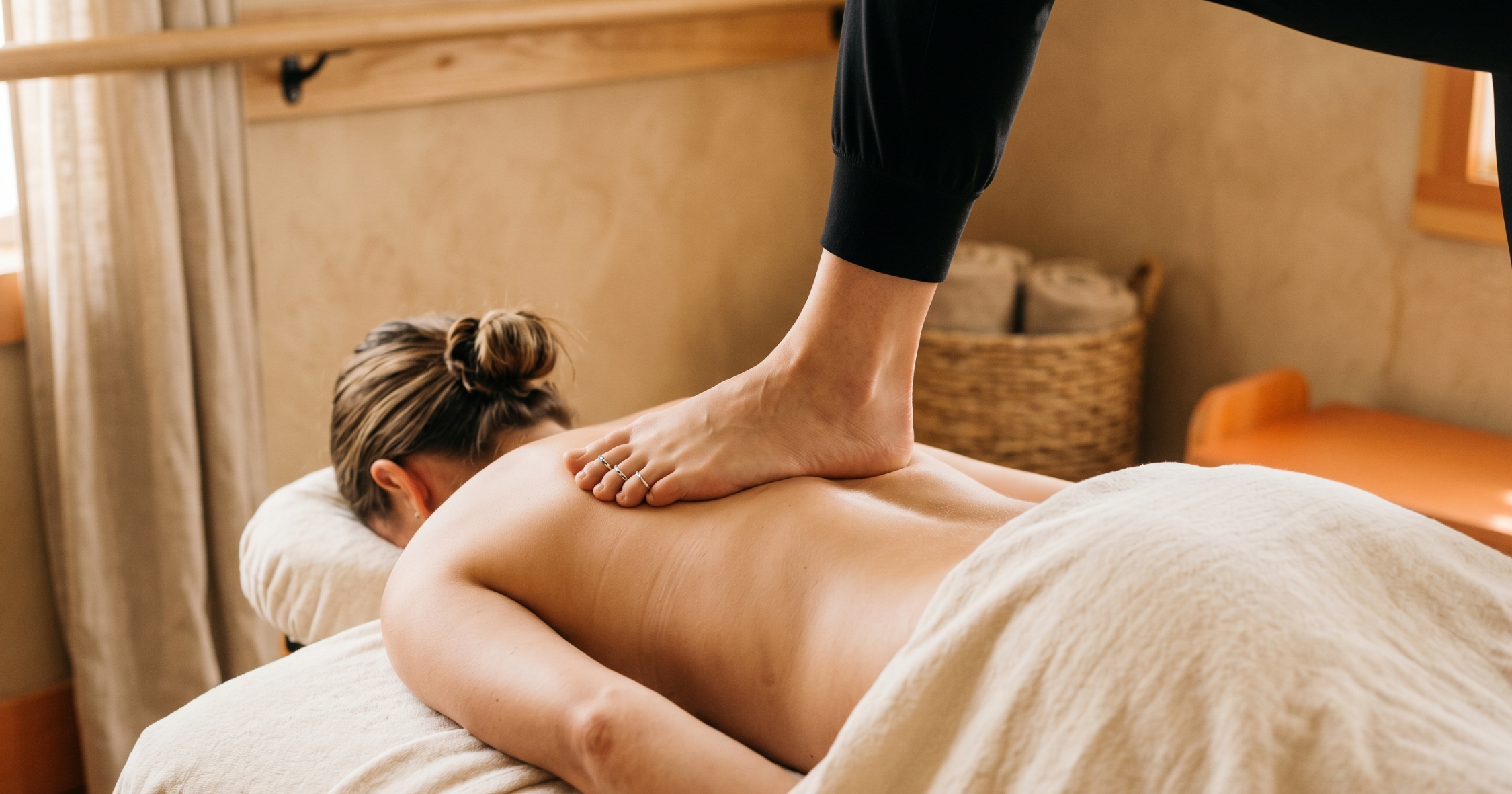
Ashiatsu is a form of barefoot massage where the therapist uses their feet, instead of their hands, elbows, or thumbs, to apply broad, deep, gliding pressure across the body. The word itself comes from Japanese: “ashi” meaning foot and “atsu” meaning pressure. Together, they describe exactly what the technique is: foot pressure massage.
In a typical ashiatsu session, the therapist stands on a padded massage table with overhead parallel bars mounted to the ceiling. The bars provide stability and control, allowing the therapist to use the bars to support and adjust their body weight precisely. This means pressure can be deep enough to release the most stubborn chronic tension. It can also be light enough to feel like a relaxing Swedish-style massage. It’s all controllable.
The result is a massage that feels surprisingly different from anything you’ve experienced before: deeper than traditional deep tissue, but smoother, more even, and far less painful. Many of our clients describe it as “the best of both worlds”: therapeutic enough to address real pain, yet relaxing enough to leave you feeling refreshed instead of bruised.
A Brief History of Ashiatsu
Ashiatsu isn’t new. It’s actually one of the oldest forms of massage in the world. Variations of barefoot massage have been practiced across Asia for over 3,000 years. In India, an ancient practice called Chavutti Thirumal developed in the southern state of Kerala, where martial artists and dancers received foot massage to recover from injuries and improve flexibility. In Japan, China, Thailand, and the Philippines, similar barefoot techniques developed alongside traditional shiatsu, anma, and Thai massage.
The modern Western form of ashiatsu, the kind you’ll receive at most American massage practices today, including Inspire Movements in Colorado Springs, was developed by Ruthie Hardee in the 1990s. After years of treating physically demanding clients with traditional deep tissue methods, she noticed her hands and wrists were wearing out from repetitive strain. Looking for a sustainable solution, she began experimenting with using her feet on a padded table while supported by overhead bars. The result was a technique that protects the therapist’s body while delivering deeper, more effective work for the client.
Today, ashiatsu has become a respected specialty within the massage therapy field, taught in certification programs worldwide and offered in luxury spas, wellness centers, and dedicated therapeutic practices like ours.
How Ashiatsu Massage Actually Works
The reason ashiatsu is so effective comes down to physics and anatomy. Here’s what makes it different from hand-based techniques:
Larger Surface Area
A foot covers a much larger surface area than a hand, thumb, or elbow. This means pressure is distributed across more tissue at once, allowing the therapist to engage entire muscle groups simultaneously instead of working one knot at a time. The result feels less like being poked and more like being firmly compressed, which most clients find significantly more comfortable.
Sustained, Even Pressure
Because the therapist can use their body weight (controlled by the overhead bars), pressure can be sustained longer and applied more evenly than is possible with hands alone. Hands fatigue quickly under deep pressure; feet supported by gravity do not. This translates to longer, more therapeutic strokes that allow muscle and fascia to actually release rather than just bracing against repeated short pushes.
Deeper Reach Without Sharp Pain
Traditional deep tissue often relies on elbows or thumbs to reach deeper layers. But those tools concentrate pressure into small points, which can be painful. The broader contact of the foot allows the therapist to reach the deeper muscle layers (like the quadratus lumborum, erector spinae, and gluteal muscles) without the sharp, “ouch” sensation of pinpoint pressure.
Activates the Parasympathetic Nervous System
The long, flowing, gravity-assisted strokes of ashiatsu are remarkably calming to the nervous system. While the work is going deep, the experience tends to feel deeply restorative. Many clients fall asleep during sessions, even when significant therapeutic work is being done.
Myofascial Stretching Effect
The gliding, sustained pressure also creates a myofascial stretch, meaning the connective tissue (fascia) that surrounds and weaves through your muscles gets elongated and freed up. This is one of the reasons ashiatsu often improves range of motion in ways that traditional massage doesn’t.
Who Is Ashiatsu Best For?
Ashiatsu isn’t for everyone, but for the right person, it can be life-changing. We see the strongest results for these client types at our Briargate practice:
People With Chronic Muscle Tension
If you’ve been carrying tight shoulders, a stiff lower back, or chronic neck pain for months or years, ashiatsu’s depth and consistency tends to break through what traditional massage can only temporarily ease. This is especially true for clients with thicker muscle mass, like manual laborers, athletes, and weightlifters, whose tissue often doesn’t respond to lighter techniques.
Desk Workers and Office Professionals
Hours of sitting create predictable patterns of tension: tight hip flexors, weakened glutes, locked-up upper backs, forward-head posture, and chronic low back pain. Ashiatsu addresses all of these areas in a single session and is one of the most efficient treatments we offer for desk-related pain. Read more in our piece on how your office chair could be destroying your lower back.
Athletes and Active Adults
Whether you’re training for a marathon, hiking 14ers in Colorado, lifting heavy at the gym, or just chasing kids around all weekend, your body accumulates wear and tear that benefits enormously from regular deep work. Ashiatsu helps athletes recover faster, improve flexibility, and prevent injuries from compensation patterns.
People Who Want Deep Tissue Without the Pain
If you’ve ever left a deep tissue massage feeling beaten up, bruised, or sore for days, ashiatsu is the answer. The broad foot pressure delivers the depth you need without the sharp, jabbing sensations that come with thumbs and elbows. Most clients walk out feeling looser, lighter, and surprisingly relaxed.
Clients With Chronic Low Back Pain or Sciatica
The lower back is where ashiatsu truly shines. The broad pressure across the lumbar region, glutes, and hamstrings releases the entire chain of tension that drives most chronic low back pain. For sciatica clients, ashiatsu’s ability to relax the piriformis and gluteal muscles often provides relief when nothing else has worked. See our deeper guide on ashiatsu massage for sciatica relief.
High-Stress Professionals and Caregivers
For people whose stress shows up as physical tension, like tight shoulders, jaw clenching, or headaches, the parasympathetic-activating effect of ashiatsu can be transformative. The combination of deep release and nervous system regulation makes it ideal for anyone who feels like their body never fully relaxes.
When Ashiatsu May Not Be the Right Choice
As effective as ashiatsu is, it’s not appropriate for everyone. The National Center for Complementary and Integrative Health notes that vigorous forms of massage like deep tissue can carry small risks for certain populations, so it’s important to know when to skip it or modify it.
Ashiatsu may not be the best fit if you have:
- Recent surgery or unhealed injuries
- Severe osteoporosis or bone fragility
- Blood clotting disorders or are on blood thinners
- Active flare-ups of inflammatory conditions like rheumatoid arthritis
- Pregnancy (we offer alternative modalities better suited for prenatal care)
- Uncontrolled high blood pressure or recent cardiovascular events
- Skin conditions with open wounds or active infections in the treatment areas
If you’re not sure whether ashiatsu is right for you, we always recommend a brief conversation before booking. Jessica can review your health history and recommend the best modality for your situation. That might be ashiatsu, traditional massage, or something else from our service menu.
Curious if Ashiatsu Is Right for You?
Book a session with Jessica at Inspire Movements and experience the difference for yourself.
Ashiatsu vs. Other Massage Modalities
If you’re trying to decide between ashiatsu and other types of massage, this comparison may help:
| Modality | Pressure | Best For | Pain Level During |
|---|---|---|---|
| Ashiatsu | Deep, broad, sustained | Chronic tension, deep work, athletes | Comfortable |
| Deep Tissue | Deep, focused, pinpoint | Specific knots, trigger points | Often intense |
| Swedish | Light to medium | Relaxation, circulation, stress | Very gentle |
| Sports Massage | Variable, technique-driven | Pre/post-event, recovery | Moderate |
| Trigger Point | Very focused, deep | Specific muscular knots | Intense, brief |
For many clients, the question isn’t ashiatsu vs. another modality. It’s how to combine them. We frequently pair ashiatsu with cupping therapy or red light therapy for a more complete pain relief experience.
Read our breakdown on why combining ashiatsu with cupping works better than either alone for the full picture.
What to Expect at Your First Ashiatsu Session
If you’ve never had an ashiatsu massage before, here’s a rough idea of how it goes:
Intake Conversation
Jessica will start with a thorough conversation about your pain history, daily activities, previous injuries, current medications, and goals. This is essential. It shapes the pressure level, focus areas, and pacing of the session. Bring up anything that feels relevant, even if it seems minor.
Setting Up the Table
You’ll lie face-down on a padded ashiatsu massage table, draped modestly with linens. Above the table are two parallel wooden bars mounted to the ceiling. These allow Jessica to safely control her body weight and pressure. The setup is professional, controlled, and surprisingly comfortable.
The Massage Itself
Jessica will use her bare feet, which are clean, well-maintained, and warmed, to apply long, smooth, gliding strokes across your back, glutes, hamstrings, and shoulders. The pressure is deep but never sharp. You’ll likely feel like you’re being firmly compressed into the table in a deeply satisfying way. Pressure is fully adjustable throughout the session, and you should always speak up if anything feels too intense or too light.
Repositioning
Halfway through, you’ll typically flip over to face-up so Jessica can address the front of your body: chest, abdomen if appropriate, arms, and legs. The face-up portion uses more traditional hand techniques alongside continued foot work where helpful.
After the Session
Most clients feel noticeably looser, lighter, and remarkably relaxed. Some experience mild soreness the next day (similar to a workout), but rarely the deep bruising sensation that can come with traditional deep tissue. Drink plenty of water, take it easy on heavy lifting for 24-48 hours, and pay attention to how your body feels over the next few days. For more details, see our full guide on what to expect during your first ashiatsu massage.
How Often Should You Get an Ashiatsu Massage?
Frequency depends on your goals and current condition. Here’s how we typically structure care plans:
| Goal | Recommended Frequency | Session Length |
|---|---|---|
| Acute pain relief | Weekly for 4-6 weeks | 90-120 min |
| Chronic tension | Bi-weekly | 60-120 min |
| Maintenance & prevention | Bi-weekly to monthly | 60-90 min |
| Athletic recovery | Weekly during training | 60-90 min |
| Stress management | Bi-weekly | 60-90 min |
For more on cadence, our deep dive on how often to receive ashiatsu massage walks through the rationale behind these recommendations.
Common Questions About Ashiatsu Massage
Is ashiatsu safe?
Yes. When performed by a properly trained therapist, ashiatsu is a safe and well-tolerated form of bodywork. The overhead bars give the therapist precise control over pressure, and the broad foot contact distributes force more evenly than hand-based techniques. As with any deep modality, it’s important to communicate with your therapist throughout the session and to disclose any health conditions during intake.
Will it hurt?
Most clients are surprised by how comfortable ashiatsu feels, even at deep pressure. The broad surface area of the foot means you don’t get the sharp, jabbing sensations that can come from elbows or thumbs. You may feel intense pressure or “good pain” in tight areas, but it should never cross into actual discomfort. Always speak up if it does.
How is the therapist’s foot? Is it clean?
Ashiatsu therapists take meticulous care of their feet. Feet are washed thoroughly before each session, kept clean and well-maintained, and the practice is held to the same hygiene standards as any other professional bodywork.
Will the therapist’s full body weight be on me?
No. The overhead bars allow the therapist to support and distribute their weight precisely. They can apply anywhere from very light pressure (just enough to glide across the skin) to deep therapeutic pressure. It’s all controlled and adjustable. The bars give the therapist far more control than they’d have with hands alone.
Can I get ashiatsu if I’m bigger or smaller than average?
Generally yes, but ashiatsu certifications often recommend that therapists not perform two-footed advanced techniques on clients more than 50 pounds lighter than themselves. At Inspire Movements, Jessica adjusts her approach to suit each client’s size and needs. If you have concerns, mention them during your initial conversation.
Experience Ashiatsu in Briargate, Colorado Springs
Ashiatsu has been our signature modality at Inspire Movements for years, and it’s the foundation of how we approach chronic pain, deep tissue work, and long-term wellness for our clients. Whether you’re dealing with stubborn low back pain, recovering from an athletic injury, navigating chronic stress, or just curious about what truly deep, comfortable bodywork feels like, we’d love to introduce you to it.
We serve clients throughout Briargate, Research Parkway, Academy Boulevard, and the I-25 corridor in Colorado Springs. Jessica’s training in ashiatsu, cupping, and integrative pain therapy means every session is tailored to your body, your history, and your goals, not a one-size-fits-all approach.
If you’re ready to try a form of massage that feels nothing like what you’ve experienced before, we’re ready to welcome you in.
Ready to Try Ashiatsu?
Book your first ashiatsu session with Jessica at Inspire Movements and experience what truly therapeutic, comfortable, deep bodywork feels like. Located in Briargate, Colorado Springs.